Monday, June 18, 2018

I’VE BEEN INSPIRED BY STEEL BONES


I am privileged to be a Trustee with a wonderful charity called STEEL BONES. Our Charity supports people with Limb loss and particularly, the families of those who have experienced the trauma of amputation following accident or ill health.


Amputees, Group, Steel Bones
Just a few of the many STEEL BONES family and friends team.


I am not an amputee myself but through my work with STEEL BONES I have been fortunate to meet many people with missing limbs and am constantly impressed with their attitude and outlook on life.


People who know me well, know that I am a runner. I have been running for many years. 

So, I had this idea of running x3 Ultra Marathons.


Runner, runners, pack of runners, running race
A young Steve Morley on a rare occasion leading the pack


So, the name of this Challenge is: Steve's 3-Ultra Challenge. #Steve's3UltraChallenge


People who know me well, know that I am a runner. I have been running for many years. I run marathons and in recent years I have taken on the challenge of running Ultra Marathons.

So, over the coming months I will be taking on a 3 Ultra Challenge. I plan to run three Ultra Marathons over increasingly longer distances. 


My first Ultra Challenge would be the
Kings Forest Ultra which is 50k, approximately 31 miles. Ultra number two is the Peddars Way Ultra, from mid Suffolk to the North Norfolk coast, 74k or approximately 46 miles and the third and hardest Ultra is the Norfolk Coastal Ultra, 100k or 62 miles.


This challenge originally had a working title of "The Old Guy has finally lost it this time" Perhaps a bit of a mouthful. So I will just stick with the 3-Ultra Challenge

My challenge starts in October 2019 with Ultra Number 1. Ultra Number two is January 2020 and the final Ultra is June 2020. So the challenge will be spread over approx. 6 months with roughly the same amount of time for me to train and get into shape for the first Ultra in October..  

I will also be running a few traditional Marathons as part of my training, with the first being the  Mablethorpe Marathon on in early October as a little warm up for Kings Forest.

Each race will bring its own unique challenges. Peddars Way is run in January and is often run in blizzard conditions with several runners getting hyperthermia. Ultra number three takes place in June at the height of the summer. So, lovely warm weather for a stroll in the countryside but maybe not ideal conditions for a 100k race. The easiest, on paper, is Kings Forest since it's the shortest. However, it's through a forest and the terrain is undulating and can be difficult. 


So, wish me luck,


Ideally, I would like to raise some money for our Charity, STEEL BONES which is dedicated to supporting amputees and their families. Any money raised will be spent promoting our work in schools and in the community.


I will shortly be setting up a “Just Giving” page. So, watch this space and Please make a small donation if you can.  


Catch you next time.


Sunday, June 10, 2018

Exercise and disability.

Hi folks and welcome to my latest Blog post. A while back I produced a series of videos which were filmed at the Inspire Fitness Gym, in Suffolk. The videos were aimed at Coaches, Gym Instructors, Personal trainers and others who might be providing an exercise program for someone with a disability. There were six videos in total, covering areas such as Physical, Sensory, Emotional and Cognitive disabilities as well as looking at Mental Health conditions. The videos were designed to give people a brief overview of the conditions, along with some practical advice to help instructors better support their clients.

Wheelchair users, fitness, inclusive gym
Today's Blog is based on the video that dealt with physical disability and it follows on quite nicely from a post I wrote a few weeks back called "The importance of functional fitness to amputees".


In today's post we are going to be talking more generally about physical
disability, not just amputees. So we are thinking about, Wheelchair users, people with spinal injuries, cerebral palsy, muscular dystrophy and people with conditions that generally affect their muscular skeletal, circulatory and nervous system.

So, if you are working with a client with a physical disability, or indeed any disability, it's important that you find out as much as you can about the condition. The best to do that is to ask. Have a conversation. Unlike someone with a neurological disability, who may find it harder to communicate, generally someone with a physical disability will be happy to talk about their condition. After all, they own their physicality. They are the experts since they live with their condition 24/7

Rowing machines, gym, inclusive exercise sessions.
So, where do we start? Well at the beginning it's best to establish some parameters. What is their current level of fitness, range of movement etc... This is going to set a bench mark and help you to work with your client more effectively. So for example, if your client is a wheelchair user, they may have damaged their spinal cord resulting in paraplegia, affecting movement of their lower body. Or, they have more severe damage resulting in Tetraplegia affecting all four limbs with possible issues affecting other parts of their body.

Wheelchair user, volunteer, Inclusive Sports.
So it's obviously important to establish how much loss of movement there is, and this may well vary from person to person, even between people who appear to have a similar condition, even having damage to the same part of the spinal cord. On the other hand, if you are working with someone that has cerebral palsy, you may have more scope to work with them. Whilst they may find some exercises challenging, there is no reason why gentle routines designed to extend a client's range of movement shouldn't be affective. Their physical condition and range of movements may never be as great as someone without the disability, but general fitness, balance, coordination and range of movement can all be improved.


On a practical level, when working with someone with limited mobility, think about seated exercises. If you have had any experience working with older adults you will have come across Chair Based exercises.


These are a really good place to start, because it enables you to assess your clients physicality and what they are capable of. Even if you want to move them on quite quickly to a more rigorous exercise regime, this type of more controlled exercise gives you more scope and flexibility when it comes to careering for your client. Chair Based exercises enable you to ensure that they are stable and you can monitor closely their level of fitness, which might be quite low. In any event, they are likely to fatigue more quickly. If they are seated this will be a safer position for them.


Resistance band, Exercise, Gym, Inclusive Exercise.
Consider using exercise bands sometimes called resistance bands. Resistance bands are brilliant. They can be used lying down, standing and seated. So they are perfect for wheelchair users.

You can also use dumbbells. Small dumbbells are good because sometimes you may have clients with difficulty with their grip. Wheelchair users my have difficulty keeping their heart rate up so you need to be keeping their upper body moving and working out with small dumbbells work well. With people who have physical disabilities make sure that you build in sufficient rest periods into your routines. Recovery is key if your client is going to progress. I mean you know that as fitness professionals, but it's even more important with someone with a physical disability.

Amputee, Treadmill, Exercise machine, Gym
I do a lot of work with amputees, particularity amputees with lower limb loss. So the work that I do in the gym is based around balance and strengthening the Core and functional fitness generally. My work also tackles issues of confidence. Confidence regarding working out in a gym environment generally but also confidence in the use of their prosthetic. 

Many people have a problem with feeling that they can't rely on their prosthetic and this makes them feel unsteady on their feet.  Working on balance improves confidence.

The bottom line when working with a client that has a disability is to allow a little more time. Patience is key, like a lot of things in life.

Not everyone that you work with will want to become a Paralympian but do allow yourself the space to work with your client effectively and help them be the very best that they can be. The fact that they have a disability shouldn't mean that you do any less. 

See you all next time. 

Bye for now.


Wednesday, June 6, 2018

Supporting vulnerable children using Inclusive and Adapted sport


I think we can all appreciate the huge potential that physical activity has to enhance our wellbeing. Even relatively short bursts of exercise like going for a brisk walk can increase our mental alertness, energy and generate a positive mood. 


So when it comes to our kids, I'm sure that we fully embrace the value of exercise to our children’s Health. However, we often assume that because kids are kids, they have energy to burn and get all the exercise that they can handle, at school and from enjoying all kinds of sport. But guess what?

NOT ALL KIDS LOVE SPORT.   SAY WHAT?


Monkey,
It seems, It’s about perception.  A recent survey explored how young people regard sport. The survey divided children into two groups, Sporty and Non-Sporty 

So, how do SPORTY KIDS think about sports?


When speaking to the young people, in the "Sporty" group, the activities that they most associated with sport tended to be what might be considered ‘traditional sports’, such as: Rugby, Football, Hockey, Tennis and Athletics.

Young Adults, Sports, Basktball
Someone like Joe here, is convinced about the merits of Sport. 
Joe said, "When you’ve had a tough training session and you’re really feeling it, you know you’ve worked hard and it just makes you feel good." 
Physical activity has been shown to have a positive impact on our mood. There are many studies that seem to show that people felt more content, more awake and calmer after being physically active compared to after periods of inactivity. They also found that the effect of physical activity on mood was greatest when mood was initially low.
Non-Sporty-Bored-Fed up, not included
Interestingly, the survey showed that there were several instances where young people that viewed themselves as ‘non-sporty’ were involved in fitness or active lifestyles but didn’t see that as sportiness.  

This included: Horse riding, cycling to get about, walking, yoga.


Someone like Pete here, really wasn't Bored, Fed up, non-sporty, not included

convinced of the merits of competitive sport.  Typically agreeing with statements such: 
"In PE it’s not like we’re playing in a cup match, but some people take it so seriously and are so competitive – it really takes any fun out of it.”


Impact on self-esteem

Exercise not only has a positive impact on our physical health, but it can also increase our self-esteem. Self-esteem is how we feel about ourselves and how we perceive our self-worth. It is a key indicator of our mental wellbeing and our ability to cope with life stressors.

Physical activity has been shown to have a positive influence on our self-esteem and self-worth. This relationship has been found in children, adolescents, young adults, adults and older people, and across both males and females.

So, how can we better engage with children like Pete?


Adapted-Inclusive-Baskingball-Sports


What we learnt from Disability SPORT. 

Adapted and Inclusive sports activities were designed to engage and support people with a disability. We have found that for sports and sporting activities to engage, they must.....


Provide a challenging yet fun experience. They must be a safe and inclusive activity. They should provide opportunities for expression. Sports that are specific or adapted, have to be 

Easy to take part in. Be able to accommodate all skill levels. Be flexible regarding competition. They should also provide
a sense of belonging: a feeling of being respected, valued for who you are.
So, It’s NOT just about Disability

Adapted-Inclusive-Sitting-Volleyball
Adapted and Inclusive Sports, Like Siting Volleyball are great fun and they Engage. They work!  Table Cricket or Polybat. Soft, easy to do activities.


Adapted-Inclusive-Table Top -games
These types of activities can provide the  perfect  "Hook" to engage with "Non-Sporty" kids but still have all the physical and mental health 
benefits listed above.

So, how can we better engage and deliver to both our Sporty and Non-Sporty kids?  Well, let’s Mix it up.
A mixture of traditional, non-traditional and non-competitive activities is key to developing a successful inclusive PE programme engaging all students.
Level the playing field.
Sitting-volleyball-level-playing field -Inclusive sports
Play floor activities where everyone is on the same level (e.g. sitting volleyball).

Whilst there is still a big demand for traditional sports such as rugby and football in school, 

introducing new sports such as Sitting Volleyball, Boccia and simulated Visually Impaired activities such as Goalball has been highly popular with students.
The bottom line. Make it Fun and make it Inclusive.


Monday, June 4, 2018

Who are you calling disabled?


I’m interested in how we use words to describe and define things in our society. I’ve been working as a Disability Sports Coach for several years and deliver disability awareness training and coaching workshops designed to help young coaches engage more effectively with people with disabilities.

At some point during a training session or workshop we will inevitably cover the subject of communication and labels. I do an exercise with two headings- Acceptable or Not-Acceptable. I then hand out small cards printed with the names of the usual suspects: wheelchair user, wheelchair bound, blind, visually impaired, autistic, retarded etc., etc. I ask the participants to put the cards under the heading they think are most appropriate. The exercise is always very popular with some descriptions and definitions more obvious than others.


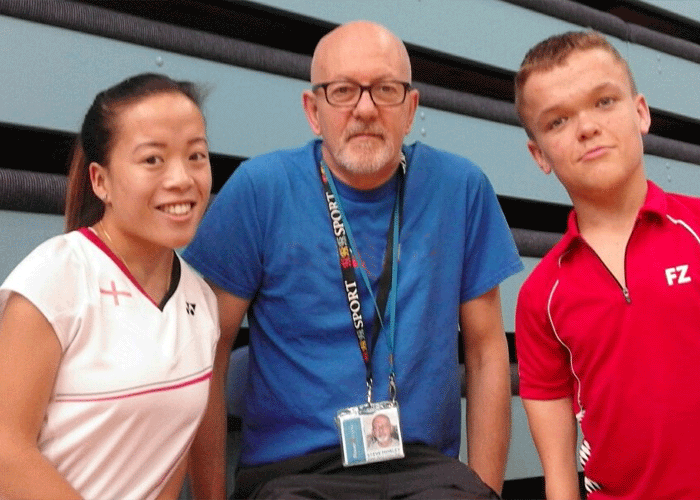
Para, Badminton, Short Stature, Inclusive, Disability

One that often confuses people is Dwarf. Some put that under the Not-Acceptable heading even though the term Dwarf has been used as a category in various Para Sport events for years. Language is constantly changing and now the term short statue is often substituted. Some people of “Short Statue” are perfectly used to and take no offence to the word Dwarf.


Disababled, Cartoon, DrawingOne of my favourite and most common example, is a toilet Accessible or Disabled? Of course, we all know, don’t we boys and girls, that the correct term is Accessible since a Disabled Toilet is a toilet that is Out of Order?


Amputees, Disability, Mountain Climbing.I shy away from the term “disabled person” preferring to use “a person or persons with a disability”. However, many organisations suggest we should use the phrase “disabled person”.  My work brings me into contact with Special Needs children and when I hear a child described as a “physically disabled boy or girl,” I feel that It places the emphasis too much on the disability, suggesting that their differences are the only things we need to know about them.


Labels are not the problem. The dictionary defines label as “a descriptive word or phrase applied to a person, group, theory, etc., as a convenient generalized classification” However in a world that is becoming ever more politically correct, with new definitions such as “able-disabled, differently-abled, handi-capables, and people with differing abilities”, does calling someone a person with a disability, really make any difference? After all, presumably they know that they are a person; they don’t need us to tell them.
Downs Syndrome, Disability, Caring, Supporting, Inclusive
Does what we call a person result in them being treated with any more understanding? Perhaps changing attitudes and assumptions is what we should strive for rather than being so preoccupied with labels. Of course, changing attitudes and values is a much more difficult task than simply changing language. Perhaps that is why we “able bodied”, sorry, “non-disabled” people spend so much time agonising over labels, definitions and descriptions. 


Changing the label, we use to identify or classify a person’s disability won’t lessen the impact of their disability. Changing Societies attitudes just might.


Friday, June 1, 2018

Equality, Diversity, Inclusion, Sport and me!


My name is Steve Morley. I am an Inclusion Coach. So, what exactly is an Inclusion coach?
it’s someone who is passionate about Inclusion. The definition of Inclusion is - the action or state of including or of being included within a group or structure. In many parts of our society people are simply not included. Some people are constantly subjected to various forms of inequality or discrimination. Some people become marginalised or victimised due to their physicality, race, gender or sexual orientation. This Inequality permeates our World, affecting everything from day to day living through to our businesses, commerce and government. We seem to be living in a “Me First” Society where community and common good has given way to “what’s in it for me?”
Sports Coach, Inclusion, Adapted Sports, School Sports

From an early age I had two great interests, Sport and Business and was moderately successful at both. I wanted to be a top sports star and I wanted to be rich.  I had a very blinkered view of the World, was very selfish and very competitive. However, financial problems and family health issues began to change my attitude to life. When I had a heart attack in 2010 it felt like the metamorphosis was complete. I can’t pretend to have had an Epiphany, but I did start to see the World in a different way. I took early retirement and began working for local charities, coaching and providing inclusive and adapted sports for children with disabilities. Since then my “job description” as an Inclusion Coach has evolved.
Public Speaking, Teachers, Talking, Inclusion, Schools
 Last year I formed a business called “Ifnotme -inclusion coaching Ltd and, for me, being an Inclusion coach means being an educator, a trainer and a facilitator. I use my experience in the sporting world, to create opportunities for disenfranchised people to be “Included” and, working with companies and organisations I try to help people reflect on these issues, to live a more balanced life and to become more authentic human beings.


I do my very best to practice what I preach and try to, as the quote says,
“Be the change you want to see in the World”  
My work gives me the opportunity Wheelchairs, Fitness, Exercise, Gym
to work with
many “hard to reach groups” for example people with disabilities. Of course, as a Sports Coach, I use Adapted and Inclusive sports to engage and support.
 

Bored, Excluded, Not interested.
However, many non-disabled young people have a troubled relationship with PE, sport and physical activity too.
One thinks about the young person with issues about their body, those overweight or underweight. Or those with eczema, scars or other physical conditions which cause them embarrassment. Young people with low self-esteem, self-image or confidence.
Those who struggle with English, or from a culture where families are culturally conservative or tend to gender stereotype and so think PE and sport are not for girls. The young woman who feels being good at or enjoying sport makes her look unfeminine. What about the boy who is worried about getting hit by the cricket ball, or hurt in the football tackle? Or Boys who don't like sport or PE but whose family put pressure on them to be 'sporty'. And, Girls or boys from families who themselves have had negative experiences in PE or sport.
Public speaking, Talking, Workshop
All the above can benefit from a more inclusive and adapted approach to sport. That is what I preach.
The definition of Inclusion, after all, is - the action or state of including or of being included within a group or structure.


I’m sure we all know people who dreaded sports days and would have given anything to avoid the PE class. By using adaptive, inventive and inclusive activities we can often engage with children who, for many reasons, are not drawn to or naturally good at mainstream and traditional sports.
Everybody should be able to experience the joy that taking part in sport can bring, the connections that can be made, the sense of accomplishment and the feeling of being part of something bigger.
Seated sports, Adaped Volleyball, Inclusive.
Most importantly, let’s take the dread out of sport and by making it “Inclusive”, make it FUN for all!